Salary range transparency provides organizations the opportunity to make visible their compensation philosophy, remedy pay gaps and disparities, and address any concerns about the wage gap proactively.
Salary range transparency is the practice of including realistic salary ranges on job postings. It is an approach to compensation that invites and demands transparency from employers, working against the longstanding norm that salaries are kept secret. This effort is becoming the norm across the United States, and is also becoming law in more and more states.
What is Salary Range Transparency?
This approach to transparency begins at the beginning of the relationship between employers and job seekers, when jobs are listed with realistic salary ranges. This includes transparency about salary range in both job descriptions and advertisements to transparency in salary banding when developing a compensation philosophy.
Salary range transparency provides organizations the opportunity to make visible their compensation philosophy, remedy pay gaps and disparities, and address any concerns about the wage gap proactively. We believe that salary range transparency is a vital step toward pay equity in our field. When salary ranges are not present on job postings, it is one component of and a contributing factor in pay discrimination, which fosters systemic gender and race-based disparities inside our professional spaces that impact women, people of color, LGBTQ+ people, and mothers. By making salary ranges transparent on job descriptions and advertisements, workplaces are taking a healthy and helpful first step to level the playing field in negotiations, so that women and others belonging to historically marginalized groups don’t lose out.
For the purposes of our work, we focus here on salary range transparency in the recruitment and hiring phase.
Why Salary Range Transparency?
Including salary range on job postings leads to greater pay transparency and greater equity in our field. It helps put job seekers on more equal footing with potential employers and is good for business.
Employers expect job seekers to share what they bring to the table–usually in the form of a resume, cover letter, and references. In the same way, it is reasonable for job seekers to expect to know what the employer offers in return. Employers have a budget and range in mind, and not sharing that range is deceptive. We rely on our salaries to pay the bills. It is only appropriate and fair that salary be a part of the conversation from step one.
Salary is one helpful indicator that a job is or isn’t right for someone. Posting salaries can help both organizations and applicants save time by not pursuing opportunities that aren’t the right fit. It’s frustrating and wasteful for both parties to put in a significant amount of time that ultimately doesn’t work out because of salary. This is especially relevant in the Jewish community, in which title is not necessarily indicative of pay level, nor consistent across the field.
Data from a variety of sources show that men benefit more from negotiation than women, because current societal norms and stereotypes award men for assertive behaviors, whereas women are conversely penalized for those same behaviors. This means that even when women are trained to negotiate (which is often not the case), employers view their negotiating negatively.
In addition, not posting salaries contributes to a general lack of transparency around pay: potential and current employees don’t understand how their salary compares to others. Employees can’t know if they’re being underpaid. Likewise, employers can’t assess fair market salaries without data.
Salary range transparency also helps organizations find the right candidates first, simplifying processes, and filtering out those who are not the right match for the position. This form of transparency encourages and assures budget alignment. When working with candidates directly, salary range transparency streamlines negotiation and allows for effective communication. And of course, when applied internally with current employees, it creates the possibility, with salary banding and more robust compensation philosophies, for a system for advancement and salary increases that is respectful, efficient and transparent.
Not including salary range makes it easier for organizations to engage in inequitable practices, like asking candidates to provide salary requirements and/or salary history (now illegal in many states and localities), which both perpetuate underpayment. These practices are not equitable, and disproportionately hurt women, people of color, LGBTQ+ people, and other historically marginalized communities. When employers post a job, they know they have a budget in mind, and the easiest way to avoid these big equity “no-nos” is to share the salary range!
Simply put, we believe that salary range transparency:
- Is evidence of an organizational commitment to transparency, trust, and equity
- Improves motivation, loyalty, and performance and inspires trust in current and future employees
- Supports the reach for “right fit” for both employers and job seekers
- Helps to facilitate fair and equitable negotiations between employers and job seekers, especially for women and people of historically marginalized communities
Guarantees that time is used most efficently- for both employers and prospective employees - Streamlines hiring by filtering out candidates who are not a match
- Removes an obstacle to the further widening of pay and equity gaps that continue to affect women and people of historically marginalized communities
- Mitigates implicit bias and stereotyping on the way into the hiring process
Our Ethical Commitments
Including salary ranges on job postings and job descriptions should be standard across the Jewish communal field.
This is a relatively small, actionable step towards greater equity. Veteran Jewish professionals strive to improve the field for new, young, and rising professionals, 70% of whom are women. Including salary ranges is one way we can lift as we climb, while ensuring a strong and diverse leadership pipeline. Jewish nonprofit organizations are benefiting financially from not posting salaries. This reality is incompatible with our Jewish values, and it is incompatible with the missions of our organizations. This is not who we want to be.
With these values in mind, we ask the following of organizations and individuals who wish to stand with us in making salary transparency the standard in our field:
Commitments for Organizations:
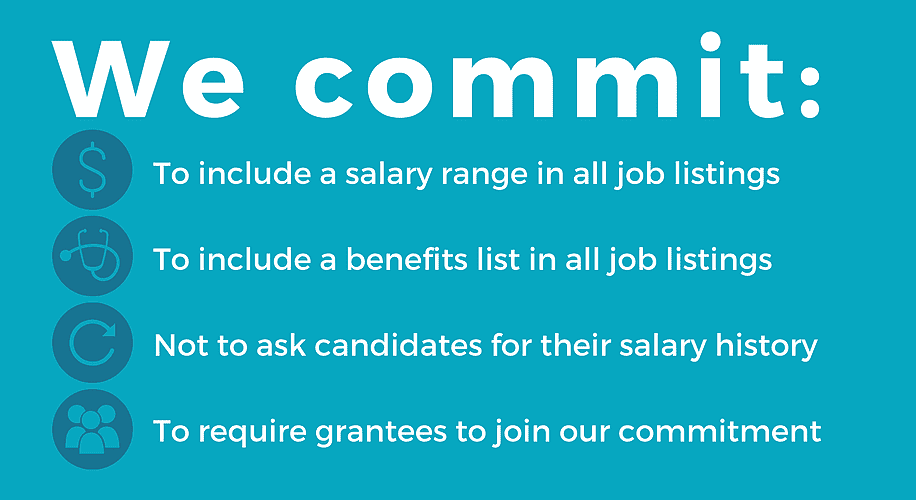
- Include a salary range on all job postings.
- Include an overview of benefits on all applicable job postings.
- Do not ask candidates to provide salary requirements or history.
As of publishing this resource, 21 state wide bans and 21 local bans are in place, prohibiting employers from asking about an applicant’s salary history, including compensation and benefits. These laws also prohibit employers from relying on salary history to determine whether to interview or offer employment. Please visit HRDive for a comprehensive and regularly updated listing. - If representing a funding organization or foundation, make salary range transparency on job descriptions and postings a requirement for both beneficiaries and grantees.
If you need help with supportive language, see our other resources for helpful language that may help to make the case.
Commitments for Individuals:
- Advocate for salary range transparency in your own organization.
- If you work for an organization that doesn’t post salaries:
- share this set of resources with your supervisors and senior management and encourage them to take these steps toward greater equity.
- share these resources with your colleagues and other members of the staff at all levels and encourage them to take this step as well.
- Share these resources with laypeople with whom you work and encourage them to advocate for these changes from within their role, either as committee members, board members or community members, or in whatever capacity they serve.
- When seeking employment, ask for the salary range if it’s not posted.
- If you see a job posting that doesn’t include salary range, reach out to the organization (or the person who posted it), and initiate a conversation about the importance of salary range transparency.
If you need help with supportive language, see our other resources for helpful language that may help to make the case.
Suggested Persuasive Language
Knowing your strategy helps you to make the case for yourself–and for the work. Here are some possible responses when faced with a specific salary range transparency issue.
For responses to absence of salary range:
“I noticed that this job posting (or advertisement) doesn’t include a salary range…”
- “Could you tell me a bit more about why that is?”
- “Could you provide one?”
- “I’d be glad to speak to the person/team who wrote the job description to ask them for more information about this choice, if appropriate.”
- “I encourage adding a salary range, as it promotes pay equity in the field.”
When asked to pass along a job posting:
- “This looks like a great opportunity and I’d love to share it; however, I’m committed to promoting gender pay equity in the field so I can only pass this along with a salary range.”
- “I’d be happy to share this with my networks if you can provide a salary range.”
When you ask about salary range and the person says they can’t provide it or add it to the posting:
- “Thank you again for sharing this job posting with me. Unfortunately, I will not be able to share it without a salary range.”
- “When you’re ready to include a salary range, please feel free to let me know. I’ll look forward to sharing it with my network and with potential candidates.”
- “If you’re not yet comfortable advocating for this, I’m glad to help you formulate some language” or “If you’re not yet comfortable advocating for this, I’m glad to be in touch with the person supervising the hiring and advocate with them to make this change.”
- “I appreciate that this is hard for organizations and that some folks are not yet ready. Do you think that there’s someone inside the organization who might be a helpful resource with whom you might speak to begin to advocate for next time/for the next job posting?”
When you are approached by a recruiter or leader about a potential job opportunity (many suggestions drawn from this Forbes article):
- “What is your client looking to pay their new hire?”
- “What’s the budget your organization has set for this position?”
- (If you’re told they don’t have a number in mind) “I expect that they’ve created a budget line/budget for this position. What is that range? I want to make sure to use your time effectively, and before we go further, I want to establish that their salary range is a fit for me. Do you want to get back to me once your client knows the budget for this role”?
- “What is the salary range for this position, or similar positions with this workload at this organization?”
When inquiring with an organization about a position without a salary range listed:
- “I noticed that this position doesn’t have a salary range included. I’d like to apply, but I’d like to make sure that the salary is within my range before I do. Would you share the salary range with me?”
- I noticed that this position doesn’t have a salary range included. Would you have any more information about this? I’d like to consider applying, but I don’t want to waste [your organization]’s time if I’m not a match for the salary range.
Thanking and celebrating individuals or organizations for including salary range:
- “Thank you so much for including a salary range. This will make a meaningful difference in recruiting a diverse applicant pool.”
- “Thank you so much for including a salary range. I’m so glad to be able to share this with others.”
- “I’m so glad to see this job description includes a salary range. That tells me a great deal about how [you/your organization] value/s transparency and equity, and I’m so glad to share it with potential candidates.”
- “I’m so impressed that you all have made this shift and embraced equity to share salaries on your job postings and descriptions. I’m sure that it was hard. Thank you.”
- “I am aware that you made the change to include salary range on your job postings recently. Thank you so much for that step toward equity. I’d love to hear about how you did it, and be able to appreciate your hard work toward this goal.”
Strategies for Organizational Resistance
We can’t do this yet because….
We don’t want current staff to know what a new team member is making.
This is an important place to begin. This recognizes that the work of salary range transparency is a first step toward developing a fair compensation plan for ALL staff, and overall transparency about your compensation policies and philosophy. Reassure staff that this is a place to begin, and that steps will be taken, as your organization is creating a compensation philosophy, to address confidentiality and transparency as it evolves.
This is the way we’ve always done it.
That’s reasonable as a place to begin identifying your discomfort. It is not a way forward. Your employees depend on your decisions. This is about creating budgets that align with our values and that are honest. If we value honesty and transparency overall, we need to make sure that it is visible in our work here too. Plus, as Jews, we believe in change. We don’t still sacrifice animals at the Temple in Jerusalem–we were able to make change, and it helped us to grow and evolve. Let’s consider what good this might do for us all, too.
We’re glad to help you consider the ways in which this challenge might generate exciting opportunities for your organization to grow.
We need to be able to pay prospective employees the lowest salary possible.
Sure, nonprofits budgets are tight. That is almost always the case, and budgeting, especially with regard to salaries (which typically make up the bulk of not for profit budgets), is always difficult. This is no excuse. Don’t begin a dialogue with a future employee under false pretenses, don’t try to lowball someone, and don’t try to squeeze them. It is disrespectful to the individual, creates a culture of disrespect inside your organization, and makes a very clear statement about how your organization conducts business (not a good one).
This isn’t done in other professional communities OR my colleagues in other fields say that this is not a thing, so I don’t want us to do it.
That’s true. And it’s because these fields perpetuate inequities and consolidate power in ways that preference management and disadvantage employees. They are not concerned with equity. We are. We hope that you are as well. If you want to blaze a trail toward a more equitable future for your organization, this is a great way to do so. The rest of your field, we hope, will change, and you will be an example to them.
And if you’re still resistant, or your colleagues are, please consider reading about how many fields, including human resources and talent management, have embraced this shift, in our Bibliography.
The Open Salary Spreadsheet
In November 2019, GEiHP attempted an experiment in collaborative transparency by inaugurating an open salary-sharing spreadsheet for Jewish communal professionals. Approximately 1% of all Jewish professionals in the United States participated in this effort to create a resource for benchmarking salaries and engaging in market research, as part of a communal reach toward pay equity. Since 2019, so much about our Jewish communal ecosystem has changed, but salaries have not yet changed substantially. Salary transparency norms–and laws–are rapidly changing, and our belief in transparency is firm.
The Open Salary Spreadsheet invites data shared by full-time employees across the North American Jewish communal workforce. Sharing salary and benefits data lifts up the power of transparency and builds a culture of trust and participatory community, as it works to create pay equity and narrow wage gaps. In doing this work, we hand the tools of transparency to Jewish communal professionals. We invite you to contribute by sharing your data.